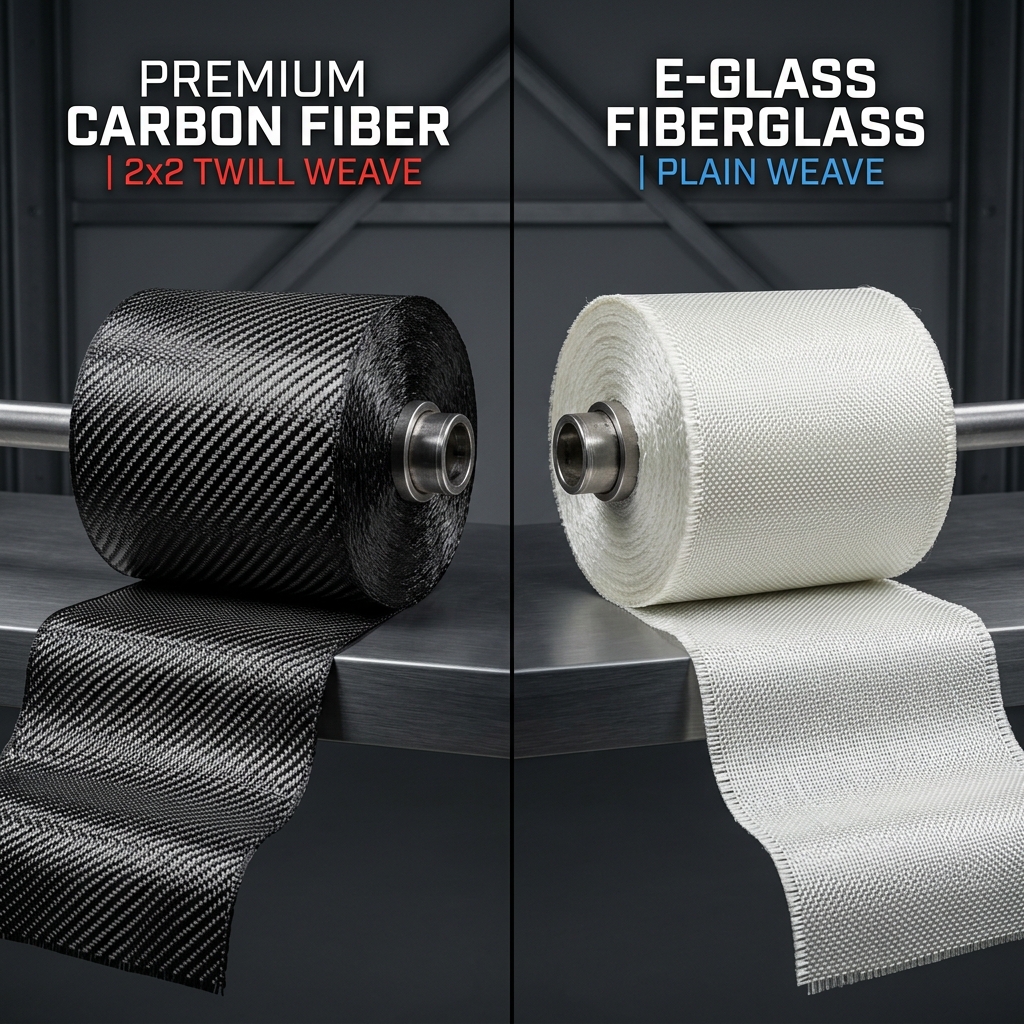
Choosing between carbon fiber and fiberglass is a balance of performance requirements, structural targets, and budget. While carbon fiber dominates the headlines for high-performance engineering, fiberglass remains a highly versatile workhorse in marine and heavy-duty applications.
Structural Property Comparison
To help select the correct reinforcement fabric, evaluate these typical mechanical and physical properties of carbon fiber vs fiberglass:
- Tensile Strength**: Carbon fiber offers 3500-4500 MPa, while E-Glass offers 2000-2500 MPa.
- Tensile Modulus**: Carbon fiber is extremely rigid at 230-250 GPa, compared to E-Glass at 70-75 GPa.
- Density**: Carbon fiber is lightweight at 1.75-1.80 g/cm³, whereas E-Glass is heavier at 2.50-2.60 g/cm³.
- Impact Resistance**: Carbon fiber has low impact tolerance (brittle), while E-Glass is highly tough and resilient.
- Relative Cost Factor**: Carbon fiber is high (4x to 6x), whereas E-Glass is very economical (1x).
Carbon Fiber: Maximum Stiffness
Carbon fiber offers the highest stiffness-to-weight and tensile strength of any commercially available fabric. It is the material of choice when weight reduction is the primary engineering driver:
- Unmatched stiffness-to-weight ratios
- Extremely high tensile strength for structural parts
- Aesthetic industrial look
- Note: Carbon is brittle, has low impact tolerance, and has a higher cost profile.
Fiberglass: Durability and Flex
Unsure which materials match your layout?
Describe your project in plain language. The Guided Buying system will analyze your application and generate a complete project blueprint automatically.
Fiberglass (specifically E-glass and S-glass) is far more cost-effective and provides superior impact toughness and flexural tolerance:
- Cost-effective material footprint
- Superior impact resistance and flexural tolerance
- Ideal for boat hulls, automotive skid plates, and protective guards
- Note: Higher weight penalty compared to carbon fiber.
Galvanic Corrosion Considerations
When using carbon fiber, be aware of galvanic corrosion. Carbon fiber is electrically conductive. If it is placed in direct contact with aluminum or steel in the presence of an electrolyte (like saltwater), it will corrode the metal rapidly. Always isolate metal fasteners from carbon laminates using a fiberglass barrier layer or non-conductive sleeve.
Optimizing with Hybrid Layups
For hybrid programs, combining both fabrics is a common optimization. Using a fiberglass core for impact resistance and cost reduction, wrapped in carbon fiber skins for structural stiffness, yields a high-performance part at a manageable price point. MACC stocks both fabrics to support whatever layup structure your engineering program requires.