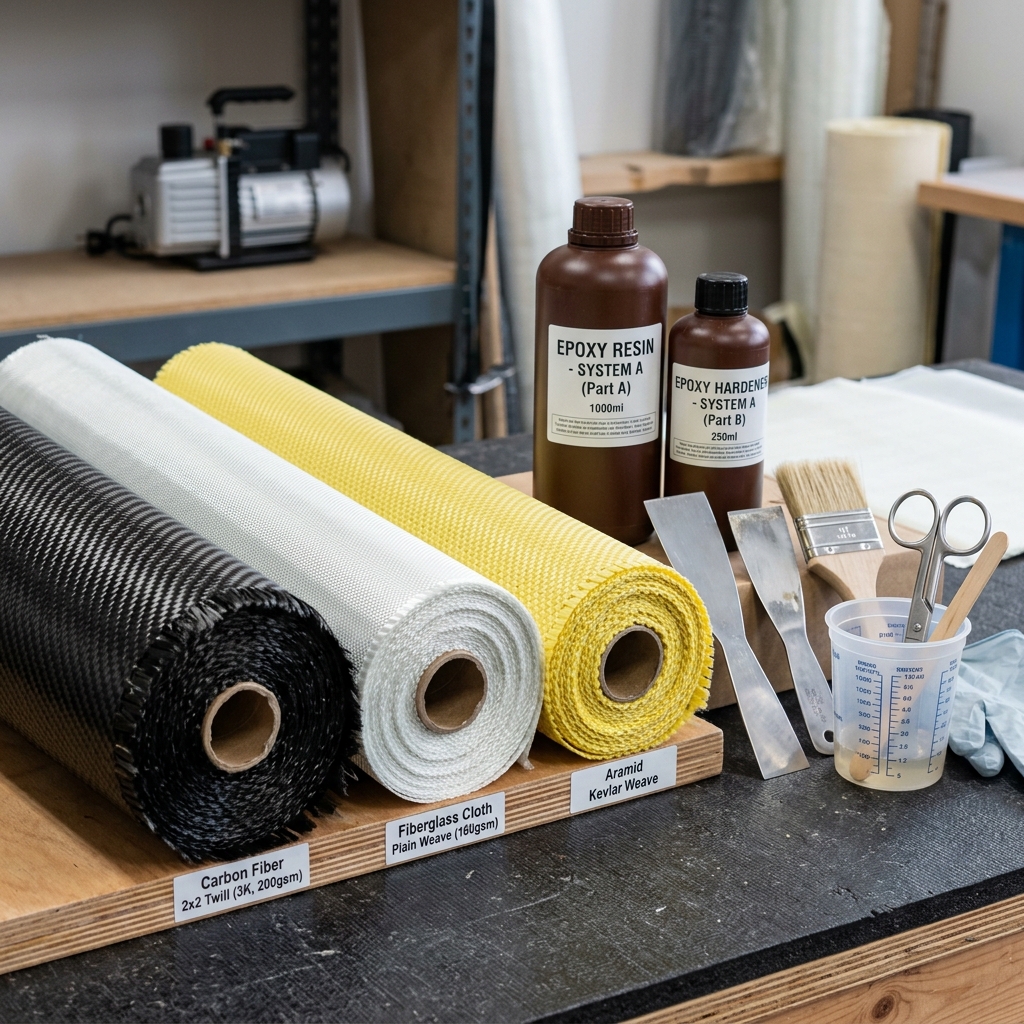
Choosing the right composite material starts with understanding your manufacturing process, structural targets, and the environment the final part will inhabit. Reinforcement fabrics, resin matrices, and backing consumables must function together as a unified system. Selecting a ultra-stiff fabric with an incompatible or low-Tg resin system will result in interlaminar failure under load.
Comparing Reinforcement Fabrics
The choice of fabric dictates the final mechanical behavior, weight, and failure characteristics of the laminate. When designing your layup, evaluate the three major performance fabric families based on your structural load requirements:
- Carbon Fiber (PAN-based)**: Provides maximum tensile strength and stiffness-to-weight ratios. PAN-based carbon fiber is the benchmark for aerospace structures, high-performance cycling frames, and automotive body panels. It is highly rigid but fails catastrophically under extreme impact without yielding.
- E-Glass / S-Glass Fiberglass**: Offers superior impact-toughness and flexural tolerance. E-glass is the industrial workhorse of marine builds, offering excellent cost-to-performance value. S-glass features higher tensile strength and is ideal for protective structural guards, leaf springs, and impact zones.
- Aramid (Kevlar)**: Superior abrasion resistance and shatter protection. Aramid fibers do not fail catastrophically; they deform and absorb kinetic energy. Frequently utilized in crash helmets, kayak hulls, and structural reinforcement patches in impact-prone areas.
Matching Resin Chemistry to Fabric Weaves
Once the dry reinforcement is selected, matching the resin viscosity and cure window is critical to ensure proper fiber wet-out and matrix compaction:
- Epoxy Systems**: Offers the strongest mechanical bond, lowest cure shrinkage (typically < 1%), and the highest chemical/environmental resistance. Essential for structural carbon fiber layups. Epoxy systems require precise mixing ratios and are sensitive to room temperature variations.
- Polyester & Vinyl Ester Resins**: Feature faster gel times and easier handling, making them ideal for rapid tooling and high-volume glass builds. However, they exhibit high shrinkage rates (up to 8%) and lower overall mechanical properties compared to epoxies.
Unsure which materials match your layout?
Describe your project in plain language. The Guided Buying system will analyze your application and generate a complete project blueprint automatically.
Environmental & Thermal Requirements
Always consider the operating temperature of your composite component. Standard room-temperature cure epoxies begin to soften around 60°C to 80°C. If the part will be exposed to engine bay heat or direct sun, a high-temperature epoxy system with a post-cure schedule is mandatory to raise the Glass Transition Temperature (Tg) beyond the maximum expected service temperature.
System Integration Checklist
Before finalizing your catalog order, check the system compatibility:
- Weave Pattern matches surface contour (twill for complex compound contours, plain weave for flat plates).
- Resin viscosity matches flow mechanism (ultra-low viscosity infusion resin for vacuum draw, medium viscosity laminating resin for wet hand layups).
- Consumables rated for maximum temperature (ensure your bag film and sealant tape are rated for any post-cure oven cycles).