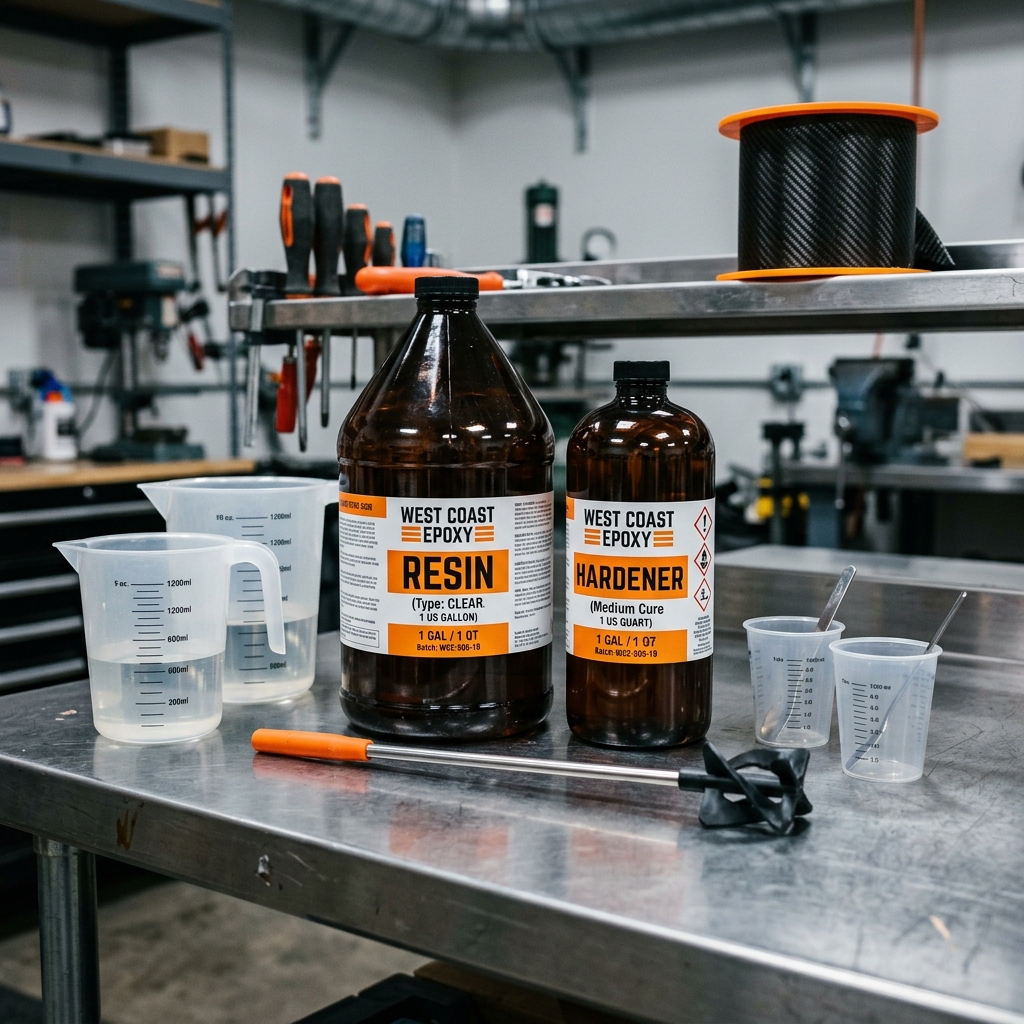
Epoxy resin is the binder that holds your carbon or glass fibers in place and transfers loads between them. Choosing the wrong resin system can result in incomplete wetting, print-through, or a weak, under-cured laminate. The selection depends on your process, cure temperature, and required working time.
Key Selection Drivers
To pair the right resin system with your project, evaluate three primary engineering metrics:
Viscosity (Flow Rate)
Wet layup systems require a medium-viscosity laminating epoxy that stays in the fabric weave without running off vertical surfaces. Vacuum infusion systems, by contrast, require an ultra-low viscosity resin (around 200-300 cps) that flows easily through the dry fibers before the gel time is reached.
Pot Life & Gel Time
Gel time is controlled by hardener selection. A 'fast' hardener is ideal for small repairs, cold workshops, or quick tooling cycles. A 'slow' hardener is mandatory for large infusions or complex wet layups where you need 45 to 90 minutes of working time to build the stack.
Thermal Properties (Tg & Post-Cure)
Unsure which materials match your layout?
Describe your project in plain language. The Guided Buying system will analyze your application and generate a complete project blueprint automatically.
Standard epoxies cure fully at room temperature but may have a lower glass transition temperature (Tg). High-performance components subjected to heat—like engine covers or splitters—require a post-cure cycle in an oven or heating blanket to achieve their maximum structural properties and thermal resistance.
Mix Ratio Precision
Epoxy cure is a chemical reaction, not a drying process. Unlike polyester resins where hardener amount can be adjusted to speed up cure, epoxy hardener must be added in the exact ratio specified by the manufacturer (e.g. 100:35 by weight). Too much or too little hardener will disrupt the chemical cross-linking, leaving you with a sticky, rubbery, or brittle laminate that must be discarded. Always use a digital scale and mix thoroughly for at least two minutes, scraping the sides and bottom of the mixing container.
Typical Post-Cure Temperature Schedule
For high-Tg tooling epoxies, a typical oven post-cure ramp schedule looks like this:
- Initial Cure**: Allow the part to gel at room temperature (22°C) for 24 hours.
- First Ramp**: Heat the oven at 1°C per minute up to 60°C; hold for 2 hours.
- Second Ramp**: Heat at 1°C per minute up to 120°C; hold for 4 hours.
- Cool Down**: Cool at less than 2°C per minute down to room temperature to prevent thermal stress cracking.